
Why Construction Firms Struggle with ISO 9001 Audits (And How to Simplify It)
Scattered sites, subcontractor paperwork and a workforce that's never in the same place twice — construction can make ISO 9001 particularly challenging to manage consistently. Here's why, and what actually fixes it.

You can walk almost any live site in the country and find broadly the same picture: inspections genuinely happening, subcontractors genuinely inducted, materials genuinely checked. What's much rarer is a system that can prove all of that happened, consistently, across every site, the moment an ISO 9001 audit asks to see it. That gap — between good practice and evidenced practice — is where construction firms can run into problems at Stage 2.
The five reasons construction audits go wrong
- Records live on different sites, in different formats, controlled by different people
- Subcontractors aren't managed the same way as direct employees
- Toolbox talks and inductions happen but aren't captured as evidence
- Material traceability breaks down between the yard, the site and the client
- High staff turnover means the QMS lives in one person's head, not the system
Five reasons construction firms struggle at audit

Records are scattered across sites
A site manager keeps inspection records in a site diary, the office keeps a separate quality file, and neither is reconciled until the auditor asks to see them side by side. Document control clauses in ISO 9001 assume records are controlled centrally — construction rarely works that way without a deliberate system.
Subcontractor control is inconsistent
Direct employees get inductions, training records and competence checks. Subcontractors — who often make up most of the workforce on any given day — frequently don't, even though ISO 9001 expects the same level of control over externally provided processes.
Toolbox talks happen but aren't evidenced
Site teams genuinely do brief inductions and toolbox talks — but if there's no signed record, an auditor has no way to verify it happened. If there's no reliable evidence, it can be difficult to demonstrate to an auditor that the activity is being carried out consistently.
Material traceability breaks down
A delivery note gets filed at the yard, the certificate of conformity stays with the supplier's paperwork, and the site team installs the material without either reaching the project file. Tracing a defect back to its source becomes guesswork.
Turnover concentrates knowledge in one person
When the QMS "lives" in the head of one site manager or a single admin person, it collapses the moment they're on leave, move sites, or leave the business — and auditors notice the gap immediately.
Common Stage 2 findings, and the fix that actually works

| What the auditor finds | The underlying cause | The simplification that fixes it |
|---|---|---|
| Inconsistent inspection records between sites | Every site manager uses their own format | One standard site inspection template, held in a shared system every site manager actually uses |
| No evidence of subcontractor induction | Induction happens verbally, nothing is signed | A one-page induction/competence sign-off required before any subcontractor starts on site |
| Missing material certificates | Certificates stay with the yard or supplier paperwork | A simple materials register linking delivery notes and certificates to the project file |
| Corrective actions never closed out | No one owns follow-up once the immediate issue is fixed | A single corrective action log reviewed at a short, regular management review |
| QMS not understood by site staff | Procedures written for the office, not the site | Site-level, one-page procedures instead of long documents nobody reads on-site |
Before your Stage 2 audit: a simple checklist

- Every live site has a current, controlled set of inspection and test records
- Subcontractors have signed induction, competence and RAMS acknowledgement on file
- Material certificates are traceable from delivery note to installed location
- Corrective actions from the last internal audit are closed out, not just logged
- Toolbox talks and site briefings are signed and filed, not just remembered
- One person owns document control across all sites, not each site manager independently
- Management review has happened within the last 12 months and is minuted
Simplifying ISO 9001 for a multi-site construction business

The businesses that stop struggling at audit tend to make the same two changes. First, they move document control off individual site managers and onto one simple, shared system — so a live inspection record looks the same whether it's site A or site D. Second, they stop trying to write procedures the way a consultant would write them for an office, and instead write one-page, site-level instructions a foreman can actually follow between deliveries.
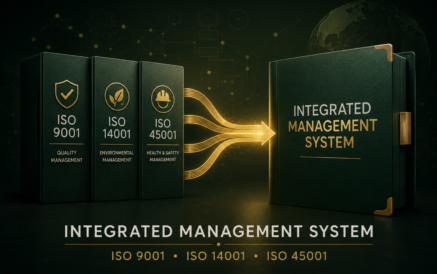
Many construction firms also hold ISO 14001 and ISO 45001 alongside ISO 9001 — waste, environmental impact and site safety are already tightly linked to quality control on most projects. Rather than running three separate systems with three separate audit cycles, an integrated management system removes a lot of the duplicated site paperwork that causes fragmentation in the first place.
Frequently asked questions
Why can ISO 9001 audits be challenging for construction firms?
Not because construction firms are less capable — but because a multi-site, subcontractor-heavy workforce makes consistent document control and evidence-gathering genuinely harder than in a single-site business. The standard's requirements don't change; the difficulty of applying them consistently does.
Do subcontractors need to be ISO 9001 certified themselves?
No. Your business needs to demonstrate that it controls the quality of subcontracted work — through vetting, induction, competence checks and inspection — not that every subcontractor holds their own certification.
Can a small construction firm manage ISO 9001 without a dedicated quality manager?
Yes, provided responsibility for document control, internal audits and corrective actions is clearly assigned to someone — whether that's an office manager, a director, or outsourced ISO management support that keeps the system running between projects.
How long does ISO 9001 take for a construction business?
Timelines depend on how many sites are running concurrently and how mature existing site paperwork already is. Our 7-step ISO 9001 implementation plan covers the general approach most SMEs follow, adapted for multi-site working.
Ready to simplify ISO 9001 across every site?
Goldenpath builds ISO 9001 systems around how construction businesses actually operate — one set of site-level records, not a filing cabinet per project.
Related Goldenpath reading
External resources: ISO — ISO 9001 Quality Management · HSE — Construction · UKAS — Accredited Certification Bodies · GOV.UK — International Standards Guidance