

ISO 9001 Benefits · UK SME Guide
Benefits of ISO 9001 for UK Businesses: Is Certification Worth It?
ISO 9001 isn't just a certificate on the wall. Done properly, it changes how consistently your business delivers, how you're perceived by customers and procurement teams, and how much rework and firefighting your team deals with day to day. Here's what it actually offers, and who it's really for.
ISO 9001 is the international standard for quality management, and it's the one UK businesses come across most often — in tender documents, in supplier onboarding forms, and in conversations with customers who want reassurance before they sign a contract. But deciding whether to pursue it is a genuine business decision, not just a compliance tick. It costs time and money to implement properly, so it's worth understanding exactly what it does for a business before committing to it. This guide sets out the practical benefits, who tends to get the most value from certification, and how the process works for a UK SME.
01 What is ISO 9001 for UK businesses?
ISO 9001 is a Quality Management System (QMS) standard. It sets out requirements for how a business plans, controls and improves the processes that affect the quality of what it delivers — whether that's a physical product, a service, or a mix of both.
In practice, that means having clear processes for things like customer requirements, supplier control, staff competence, document control, and how you handle complaints and mistakes when they happen. A business becomes "ISO 9001 certified" once an accredited certification body has audited its management system and confirmed it meets the standard.
Despite how often it comes up in tenders and supplier questionnaires, ISO 9001 certification is still relatively uncommon among UK businesses overall — a large proportion of UK companies, particularly smaller ones, operate without a formal QMS in place. That gap is exactly where the opportunity sits for businesses that do get certified.
02 What are the benefits of ISO 9001 for UK businesses?
The benefits tend to fall into two groups: what customers and the market see from the outside, and what actually changes inside the business. Both matter, and the internal changes are usually what make the external ones sustainable.
Tender and procurement access
Many public sector contracts, frameworks and larger supply chains list ISO 9001 as a mandatory or scored requirement, particularly for construction, engineering, facilities, and professional services.
Customer confidence
Certification gives customers independent, third-party evidence that your processes are documented and checked — not just a claim on your website.
Meeting supplier requirements
Larger customers increasingly ask their own suppliers to hold ISO 9001 as part of onboarding or ongoing supply chain assurance.
More consistent processes
Work gets documented and standardised, so quality doesn't depend on which member of staff happens to be handling a job.
Fewer errors and less rework
Clearer processes and root-cause corrective action reduce the repeat mistakes that quietly eat into margin.
Clearer responsibilities
Roles and ownership are defined, so problems get picked up and dealt with rather than falling between people.
Supporting business growth
A documented system makes it far easier to bring on new staff, open new sites or take on larger contracts without losing control.
Continual improvement
Regular internal audits and management review build a habit of catching and fixing issues before they become bigger problems.
None of this happens automatically just because a certificate is on the wall. The value comes from the underlying system actually being used — which is why a QMS built around how your business really operates tends to deliver far more than one built purely to pass an audit.

Key takeaway
ISO 9001 works best as a genuine operating system for the business, not a certificate exercise. The external benefits — tenders, customer trust, supplier approval — are usually the byproduct of a QMS that's actually being followed day to day.
03 Can not having ISO 9001 cost you customers or contracts?
Not having ISO 9001 will not automatically lose a business its customers. Plenty of UK companies trade successfully without it. But there are specific situations where the absence of certification becomes a real, practical barrier rather than a theoretical one.
Public sector tenders and frameworks frequently list ISO 9001 as a mandatory pre-qualification requirement, particularly in construction, engineering, facilities management and professional services. Where ISO 9001 certification is stated as a mandatory requirement, a supplier that cannot demonstrate the required certification may be unable to progress through the procurement process — you can see this requirement listed in live notices on the government's Find a Tender service. Similarly, some larger customers and supply chains use ISO 9001 as an onboarding requirement for new suppliers, or as a condition of staying on an approved supplier list.
Where certification isn't formally required, its absence can still work against a business more subtly — during due diligence, contract negotiations, or when a customer is comparing several suppliers and using certification as a quick proxy for reliability. The practical question for most UK SMEs isn't "will we lose business without it" but "which opportunities are currently closed to us, or harder to win, because we don't have it."
04 Is ISO 9001 worth it for small businesses?
It can be, particularly for small businesses looking to win larger contracts, work with bigger customers or bring more consistency to how they operate. ISO 9001 is not designed only for large organisations — it's written to apply to organisations of any size, and the standard expects the management system to be proportionate to how the business actually operates.
For a small business, that means the QMS should be lean: enough documentation and control to demonstrate consistency and manage risk, without turning day-to-day work into a paperwork exercise. Done this way, certification can deliver value through fewer mistakes, better-organised processes and access to opportunities that may previously have been closed off.
The businesses that get the least value from ISO 9001 are usually the ones that treat it purely as a badge — building a system just to pass the audit, then leaving it untouched until the next one. If you're weighing this up in more detail, our guide to ISO 9001 for small businesses walks through a practical seven-step implementation plan.
For small businesses
Size is not the barrier it might appear to be. What matters is whether your management system reflects how your business actually works — a proportionate QMS for a 12-person company looks very different to one for a 200-person organisation, and that's exactly how the standard is meant to be applied.
05 Which UK companies benefit from ISO 9001?
ISO 9001 applies across almost any sector, but certain types of UK business tend to see the clearest return on it:
- Construction, engineering and trades businesses that regularly bid for public sector or main-contractor work
- Manufacturers and fabricators supplying larger customers with formal supplier approval processes
- Professional and technical services firms competing for framework agreements or corporate contracts
- Facilities management, logistics and support services businesses working with local authorities or housing associations
- Growing SMEs that need consistent processes as they add staff, sites or service lines
- Businesses in supply chains where a larger customer has passed down its own quality requirements
It's less likely to be a priority for very early-stage businesses still finding their processes, or for organisations where neither customers nor supply chains have ever asked about quality certification. Even then, the underlying discipline — documented processes, clear responsibilities, a habit of reviewing what's not working — is useful long before certification becomes a commercial necessity.
Not sure whether ISO 9001 fits your business?
Goldenpath works with UK SMEs across construction, professional services, manufacturing and facilities management to build a Quality Management System that fits how the business actually operates — not a generic template. Explore our ISO 9001 consultant support →
06 How do you get ISO 9001 certified in the UK?
The process is broadly the same for any UK business, though the scale of work depends on how mature your existing processes already are:
- Gap analysis — compare current practice against the requirements of the standard to see what already exists and what's missing.
- Build the management system — document the processes, responsibilities and records needed to demonstrate control, kept as lean as the business allows.
- Implement and train — make sure the team understands and actually follows the new processes, not just the person who wrote them.
- Internal audit and management review — check the system is working in practice and fix anything that isn't before the external audit.
- Certification audit — an UKAS-accredited certification body carries out a Stage 1 readiness review and a Stage 2 assessment of the system in operation.
- Ongoing maintenance — surveillance audits and continual improvement keep the certification valid and the system useful year to year.
Choosing a UKAS-accredited certification body matters — accreditation is what gives your ISO 9001 certificate credibility with customers, procurement teams and tender evaluators. Once certified, the system needs to keep running rather than being filed away, which is where many businesses benefit from ongoing ISO compliance support if they don't have a dedicated quality function in-house.

07 Related standards worth knowing about
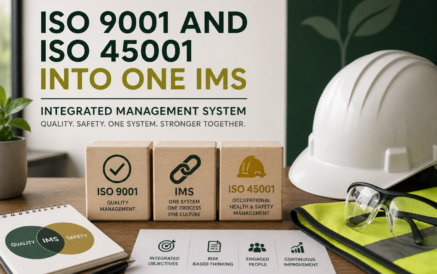
Once ISO 9001 is in place, some businesses go on to add ISO 14001 (environmental management) or ISO 45001 (occupational health and safety), particularly where customers, tenders or sector regulation ask for them. Because all three standards share a common structure, adding them later is usually far less work than starting from scratch — many of the processes, records and audit routines from an ISO 9001 system carry across directly. This is worth bearing in mind if you expect environmental or health and safety credentials to become relevant down the line, but it's rarely the right place to start if ISO 9001 isn't already in place.
Free discovery call
Not sure whether ISO 9001 would benefit your business?
Goldenpath supports UK SMEs with practical ISO 9001 implementation and certification preparation — built around how your business actually operates, so the system earns its keep long after the certificate is issued.
Book Your Free Discovery Call Or call 01553 341004 to talk it through first.Related Goldenpath pages