
ISO Compliance Insights · Multi‑Standard Compliance
What causes ISO management system fragmentation?
Why quality and safety systems become siloed in growing UK businesses — and how integrated ISO management systems support helps you build one practical, audit-ready system that actually works day to day.

Somewhere between getting ISO 9001 certified and adding ISO 45001 — or between hiring a quality manager and a health and safety coordinator — something goes wrong in many UK SMEs. The systems that were supposed to work together quietly drift apart. Policies contradict each other. Risk registers multiply. Audits become repetitive marathons that pull the same staff away from their work twice or three times a year. Internal audit findings go into different spreadsheets, corrective actions live in different inboxes, and nobody has a single view of how the business is performing against its compliance obligations.
This is ISO management system fragmentation — and it is far more common than it should be. More importantly, it is entirely preventable. Understanding what causes fragmentation is the first step toward fixing it. This guide explains the root causes, the warning signs, and how integrated ISO management systems support helps UK SMEs build one coherent, practical framework instead of several competing ones.
01 What is ISO management system fragmentation?
ISO management system fragmentation occurs when an organisation manages two or more ISO standards as entirely separate systems, with separate documentation, separate processes, separate teams, and separate compliance cycles. Each standard is treated as its own project rather than as one part of a unified management approach.
Fragmentation is not always obvious from the outside. A business might hold valid ISO 9001 and ISO 45001 certificates, pass its annual surveillance audits, and appear to be fully compliant — while internally operating two systems that never talk to each other. The quality manager and the health and safety coordinator might not attend the same meetings. The risk register maintained for ISO 9001 might share no entries with the HIRA maintained for ISO 45001, even though many risks in a manufacturing or facilities environment are genuinely shared. The management review held for quality might happen in a different month from the management review held for health and safety.
This is not just inefficient. It creates real compliance risk. When systems are siloed, incidents that span both disciplines — a quality non-conformance that has environmental or safety implications, for example — may be investigated in isolation and root causes may be missed entirely.
ISO fragmentation is not a documentation problem. It is an organisational one — and it usually starts long before anyone notices the audit burden mounting.
02 The root causes of ISO fragmentation
Fragmentation rarely happens by design. It is almost always the result of a series of individually reasonable decisions that, taken together, produce an unworkable multi-standard compliance landscape. The most common causes are:
03 Warning signs your ISO systems are fragmented
Fragmentation is not always obvious until an external auditor or a significant incident reveals it. But there are reliable early warning signs that your management systems have drifted into silos.

Fragmentation diagnostic — how many apply to your business?
- You hold more than one ISO standard but manage them through separate documents, meetings, and review cycles
- Your quality manager and H&S coordinator rarely attend the same operational meetings
- You have more than one risk register — one for quality, one for H&S, possibly one for environmental — with minimal overlap
- Internal audits for each standard are run by different people in different months
- Management reviews happen separately for each standard, sometimes months apart
- You have duplicate policy documents — a quality policy and an H&S policy — that have never been reviewed together
- Corrective actions raised during quality audits are not shared with the H&S function, and vice versa
- Your legal register for environmental law and your legal register for H&S law are maintained by different people who have never compared notes
- Staff are interviewed by quality auditors and H&S auditors in separate visits and asked many of the same questions
- You are not sure whether your ISO 9001 training matrix and your ISO 45001 competence records refer to the same training events
If three or more of the above apply to your business, your management systems are fragmented to a degree that is likely creating both compliance risk and unnecessary administrative burden. A free gap assessment from Goldenpath PM will give you a clear picture of where the overlaps and gaps are.
04 The real cost of fragmented ISO systems
Fragmentation is not just an administrative inconvenience. It has measurable costs — in management time, in audit fees, in compliance risk, and in the cultural damage caused by systems that do not reflect the way the business actually works.
| Area | Fragmented systems | Integrated IMS |
|---|---|---|
| Documentation | Multiple overlapping policies, procedures, and registers maintained by different owners | One policy, one document hierarchy, shared procedures with discipline-specific sections |
| Internal audit | Separate audit programmes for each standard; same staff interviewed multiple times per year | One risk-based audit programme; each process audited once against all applicable standards |
| Management review | Separate reviews per standard; leadership time divided; no cross-disciplinary visibility | Single annual review covering all standards; leadership sees quality, environmental, and H&S performance in one picture |
| Risk management | Parallel risk registers; shared risks assessed separately with no cross-referencing | Unified risk register; interdisciplinary risks identified and controlled once |
| Corrective action | Separate corrective action logs; same underlying cause may generate multiple separate actions | One NCR and corrective action log; root causes assessed across all disciplines simultaneously |
| Certification cost | Separate audit programmes per standard; higher annual surveillance fee total | Combined audit programme from UKAS-accredited body; lower total annual certification cost |
| Staff awareness | Different training for quality, H&S, environmental — rarely connected in staff minds | Unified IMS awareness training; staff understand quality, environmental, and safety as one system |
05 Why the Harmonized Structure makes integration the logical choice
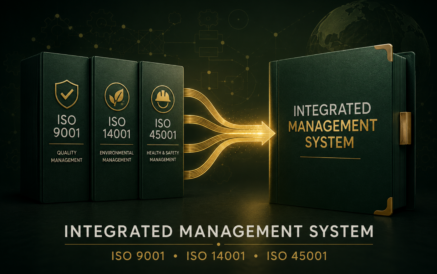
One of the most important — and least understood — facts about ISO management system standards is that they are explicitly designed to work together. Since 2012, ISO has required all new and revised management system standards to follow the Harmonized Structure (HS), previously known as Annex SL. This gives ISO 9001, ISO 14001, and ISO 45001 identical clause numbering from Clause 4 to Clause 10, compatible definitions, and significant overlap in requirements text.
What this means in practice is that the effort required to satisfy Clause 4 (Context), Clause 5 (Leadership), Clause 6 (Planning), Clause 7 (Support), Clause 9 (Performance Evaluation), and Clause 10 (Improvement) does not need to be repeated for each standard. It can be completed once, in one set of documents, referencing all applicable standards simultaneously. The only genuinely standard-specific content is in Clause 8 (Operation) and in the discipline-specific planning requirements of Clause 6 — the environmental aspects register for ISO 14001, and the hazard identification and risk assessment for ISO 45001.
Fragmentation ignores this by design. An integrated management system exploits it.
ISO's own guidance on integration
ISO publishes a practical guide specifically to support organisations implementing multiple management system standards together: Integrated Management Systems — A Practical Guide (IMS PG). This handbook provides a step-by-step approach to aligning management systems with organisational strategy, illustrated with real-world case studies. ISO's own position is clear: building one integrated system is more effective than managing multiple separate ones.
06 Where quality and safety diverge — and where they converge
Quality and safety management are often treated as entirely separate disciplines in UK SMEs — owned by different people, governed by different standards, and measured against different KPIs. In reality, they share far more common ground than most practitioners recognise.

Shared ground
Both ISO 9001 and ISO 45001 require organisations to: understand the context they operate in and the needs of interested parties (Clause 4); demonstrate leadership commitment and maintain a policy (Clause 5); identify risks and opportunities and set measurable objectives (Clause 6); manage resources, competence, awareness, and communication (Clause 7); control operational processes (Clause 8); monitor performance, conduct internal audits, and hold management reviews (Clause 9); and manage nonconformities and drive continual improvement (Clause 10). These shared requirements constitute the majority of both standards.
Where they genuinely differ
The discipline-specific differences between ISO 9001 and ISO 45001 are real but limited. ISO 9001's unique provisions centre on customer focus (Clause 5.1.2), design and development of products and services (Clause 8.3), and customer satisfaction monitoring (Clause 9.1.2). ISO 45001's unique provisions centre on worker consultation and participation (Clause 5.4), hazard identification and OH&S risk assessment (Clause 6.1.2), and emergency preparedness and response (Clause 8.2). These discipline-specific provisions sit within a unified IMS as clearly labelled sections — they do not require entirely separate systems.
The worker consultation requirement that often gets overlooked
ISO 45001's Clause 5.4 requires formal processes for worker consultation and participation in hazard identification, risk assessment, incident investigation, and OH&S management decisions. This is a genuinely distinct requirement — it has no equivalent in ISO 9001 or ISO 14001. It requires structured, documented evidence of worker involvement, not simply an open-door policy. The HSE provides detailed guidance on worker involvement that is directly relevant to meeting this requirement. It is one of the most commonly underdelivered clauses in ISO 45001 certification audits of UK SMEs.
07 How integrated support fixes fragmentation
An integrated management system — built with the Harmonized Structure as its architecture — addresses each of the root causes of fragmentation systematically. But the integration itself is not a documentation exercise. It is an organisational change that requires clear scope, committed leadership, and a structured approach.

One policy, one leadership commitment
The IMS begins with a single policy document, signed by the managing director, that covers the organisation's commitments to quality, environmental management (if ISO 14001 applies), and occupational health and safety. A combined policy does not dilute each discipline — it signals that leadership treats them all as equally important outcomes of the same operating framework, not as compliance burdens managed by separate teams.
One risk register, all disciplines
A unified risk register that incorporates quality risks, environmental aspects and impacts, and OH&S hazards eliminates the duplication and inconsistency of parallel risk management. More importantly, it surfaces the interdependencies that separate registers miss. A hazardous material in a manufacturing process is simultaneously an OH&S hazard, an environmental aspect, and a potential quality non-conformance if it contaminates product. An integrated risk register captures that connection and ensures controls are consistent across all three dimensions.
One internal audit programme
A risk-based integrated audit programme audits business processes — not standards. Each audit visit assesses the quality, environmental, and H&S performance of the process being examined, generating a single report with findings referenced to the applicable clause of each relevant standard. Staff are interviewed once. Process owners are assessed once. Findings are entered into one corrective action log. The total internal audit effort across the year is substantially lower than running three separate programmes.
One management review
A single annual management review — structured to address the mandatory inputs of all three standards — gives leadership a complete, integrated view of organisational performance. Quality KPIs, environmental KPIs, and H&S KPIs are presented together. Objectives are reviewed together. Improvement priorities are agreed for all disciplines in one session. This is both more efficient and more effective: when leaders see quality and safety performance side by side, they are better placed to make connections and allocate resource across disciplines.
What Goldenpath PM does differently
Goldenpath PM does not hand over a documentation pack and leave. We work alongside UK SMEs to understand their processes, identify where integration genuinely saves effort, and build systems that their teams can actually use. Our ongoing ISO compliance support means we are still there after certification — keeping legal registers current, facilitating internal audits, and supporting management reviews. Integration is an outcome, not a deliverable.
08 Choosing the right integrated support
Not all ISO support is the same — and the wrong approach to integration can create new problems while ostensibly solving the old ones. When evaluating providers of integrated ISO management systems support, UK SMEs should ask the following questions:
- Does the provider have demonstrable experience delivering integrated systems — not just single-standard implementations presented as integrated?
- Do they work with your existing processes, or do they impose a generic template regardless of how your business operates?
- Can they evidence completed integrated certifications for UK SMEs in your sector?
- Do they offer ongoing support after certification, or do they disappear once the certificate is issued?
- Is their pricing transparent and fixed, or based on day rates that are difficult to budget against?
- Do they understand the UK regulatory landscape — including HSWA 1974, Environment Act 2021, and post-Brexit environmental regulation — not just the ISO standards themselves?
The goal is not just a certificate. It is a management system that reduces compliance burden, improves organisational performance, and actually makes your business easier to run. A provider focused purely on certification readiness — without regard for how the system will work in practice — will produce a system that passes audits but adds no operational value.
09 Getting started: from fragmented to integrated
For UK SMEs whose systems have already fragmented, the path back to integration is structured but achievable. The starting point is always an honest assessment of where the systems currently sit.
- Commission a gap analysis: Map your existing documentation, processes, and records against the HLS clause structure for each standard you hold. Identify what you have, what overlaps, what contradicts, and what is missing. This becomes your integration project plan.
- Agree scope and ownership: Decide — at senior management level — who owns the integrated IMS. In most UK SMEs, this is either a combined QEHS role or a senior manager with oversight of all three disciplines. Without clear single ownership, fragmentation will re-emerge.
- Consolidate documentation: Rewrite shared procedures (document control, internal audit, corrective action, management review, training and competence) as single documents. Retain discipline-specific content as clearly labelled sections within the IMS structure, not as separate systems.
- Unify risk management: Merge your parallel risk registers into one unified framework. Cross-reference environmental aspects and OH&S hazards with quality risks. Review ownership and review cycles.
- Redesign the audit programme: Build a single risk-based audit programme that covers all processes within the IMS scope across a 12-month cycle. Train or appoint auditors competent against all applicable standards.
- Run one management review: Restructure the management review to cover all standards in a single meeting. Provide leadership with a unified performance dashboard before the review so they arrive with the full picture.
- Notify your certification body: If you hold separate certificates, discuss with your UKAS-accredited certification body how to transition to a combined scope. Most major bodies — including BSI and NQA — can accommodate this transition within a normal surveillance cycle.
10 Frequently asked questions
Why do companies struggle to build integrated ISO management systems?
The most common reasons are: standards were implemented at different times by different people without integration planning; separate ownership of quality and safety functions creates siloed incentives; consultants build systems for individual standards without reference to the others; and there is often a simple lack of awareness that ISO management system standards are explicitly designed to integrate via the Harmonized Structure. Understanding that ISO 9001, ISO 14001, and ISO 45001 share the same clause architecture is the foundation of effective integration.
What causes ISO management systems to become fragmented across disciplines?
Fragmentation usually results from growth — standards added one at a time, with different consultants, by different internal owners, without a deliberate integration strategy. Template-based documentation that satisfies clause requirements without reflecting actual processes accelerates the problem. Leadership treating ISO as a commercial tick-box rather than a genuine management tool compounds it. The result is multiple parallel systems that create more compliance overhead without delivering proportionate operational value. See our ISO services page for how Goldenpath PM approaches integration from day one.
Which providers offer integrated ISO management systems support for UK businesses?
Several UK ISO consultancies offer integrated management systems support. When comparing providers, the key differentiators are: whether they build integrated systems from the outset or retrofit integration onto separate implementations; whether they offer fixed-fee engagements or open-ended day rates; whether they remain engaged after certification; and whether they understand the UK regulatory landscape as well as the ISO standards themselves. Goldenpath PM provides fixed-fee integrated IMS support for UK SMEs across quality, environmental, and health and safety disciplines, with ongoing compliance maintenance as standard.
What is the best ISO management systems support for integrating quality and safety?
The best support for integrating quality and safety management is a provider who understands both ISO 9001 and ISO 45001 in depth, can conduct a rigorous gap analysis of your existing systems, and builds a unified IMS around your actual processes — not a generic template. Integration of quality and safety is particularly effective because both standards share the same Harmonized Structure and many operational processes have both quality and H&S dimensions that are better controlled together. See our page on ISO 45001 support and ISO 9001 support for how Goldenpath PM approaches each standard.
Can a fragmented ISO system still pass certification audits?
Yes — which is part of what makes fragmentation hard to detect and easy to ignore. Certification bodies audit conformance to the standard's requirements, not the efficiency of the overall compliance approach. A fragmented system can produce the documentation, records, and evidence required to satisfy each standard independently, and still pass annual surveillance audits. The costs are borne internally — in management time, audit fatigue, duplicated effort, and the compliance risks created when siloed systems miss interdisciplinary issues. The argument for integration is not that fragmented systems fail — it is that they cost significantly more to run and deliver significantly less value than a well-built IMS.
How does integrated ISO support differ from standard ISO consultancy?
Standard ISO consultancy typically focuses on achieving certification to one standard at a time. The consultant helps you build the required documentation, prepares you for the certification audit, and the engagement ends. Integrated ISO management systems support takes a different approach: it begins with an understanding of all the standards your business holds or is targeting, designs the management system architecture to satisfy all of them simultaneously, and remains engaged after certification to maintain the system's effectiveness. Goldenpath PM's ongoing ISO compliance support is specifically designed for this purpose — keeping your IMS current, audit-ready, and operationally useful throughout the year.
Free gap assessment
Is your ISO system more fragmented than you think?
Goldenpath PM provides free gap assessments for UK SMEs managing two or more ISO standards. We'll identify exactly where your systems overlap, where they contradict, and what integration would actually look like for your business.
Book a free assessmentRelated Goldenpath pages